


Career Change: 6 Mindset-Shifting Actions To Help You Embrace Abundance Beyond Money

It’s autumn and the birds are on the move. Some of the familiar tree-dwellers in my backyard are absent, having headed south for warmth and food. Others, from colder regions, have started to arrive.
I admire the birds. They don’t have reservations booked in advance, but year after year, they embrace change, taking off for different climates, trusting that, when they arrive, there will be enough resources for them to thrive.
We could take a lesson from the birds.
Making any kind of change is so scary that many of us often talk ourselves out of it before we even begin. When it comes to decisions that affect our steady paycheck, we might tell ourselves things like:
“There just aren’t enough good jobs to go around. I need to take whatever’s available.”
“I should just be grateful I have a job and work on making it to the end of this quarter/month/week/day.”
“It’s too late to start over; I only know how to do this one thing.”
But this kind of thinking is rooted in fear and it can keep you stuck.
When you adopt a “scarcity mindset,” you cling tightly to what you’ve got, afraid of change and/or believing you’re trapped.
You convince yourself that there aren’t enough opportunities so you avoid new opportunities, overlook alternatives, and lower the bar.
A bird would never.
To be more like the birds, adopting an abundance mindset is the key.
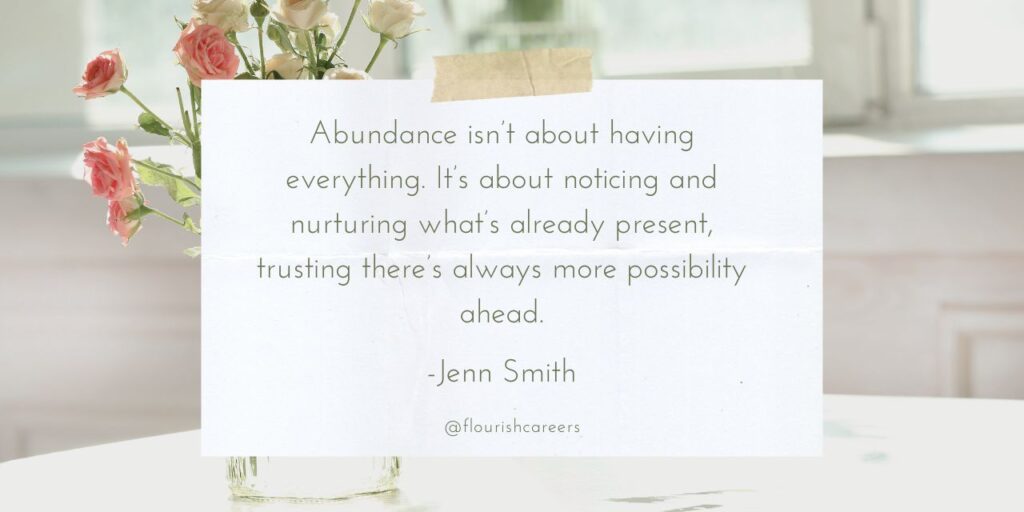
With an abundance mindset, you believe that there are plenty of resources for everyone, and you trust the cycle, knowing that even during times of rest, the next season is already on its way.
6 Specific Ways A Scarcity Mindset Stifles Your Career Potential
1. You fall into the Steady Paycheck Trap.
I know this one firsthand. I felt this fear when I took the leap from a corporate HR role to becoming a self-employed career coach and consultant. A steady paycheck gives us a sense of security and safety, and going without it—even if just during a temporary transitional period—can be scary.
2. You don’t invest in new knowledge and skills.
A scarcity mindset can hinder your ability to share knowledge or invest in growth opportunities. When you’re worried about not having enough money in the future, you may hesitate to pursue new skills or seek further education, even if those investments may bring in more lucrative opportunities in the future.
3. Job boards give you analysis paralysis.
When you’re overwhelmed by the fear of making the “wrong” career choice, you might freeze and avoid making a choice altogether. This state of inaction is known as “analysis paralysis,” and it can prevent you from exploring new opportunities, leaving you feeling stuck in your current role or industry. There’s no “wrong choice” btw 😉
4. You play it “safe.”
Taking a chance on a new career is scary! So instead, you choose to stay in your unfulfilling job within its familiar, albeit somewhat toxic, environment. It feels safe, but it’s actually one of the riskiest things you can do, stifling your creativity and career path.
5. You develop Transferable Skill Blindness.
No one likes feeling like the newbie, and you’ve convinced yourself that pursuing a new career is going back to square one. (It isn’t.) But that fear prevents you from recognizing the transferable skills and years of experience you bring to the table.
6. You come off desperate.
When you have a scarcity mindset, you may inadvertently convey a sense of desperation to potential employers. This energy can overshadow the unique value you offer.
If you’ve been living in survival mode, here are 6 ways to begin adopting an abundance mindset…
1. Start small with daily gratitude.
One of the practices that’s been most impactful for me is gratitude. It’s something that has literally changed my brain—shifting me out of the dread I used to feel in jobs that drained me. Gratitude has taught me to see the small sparks of joy that are already present, even in difficult seasons.
That’s why I added a section to the In Season planner called “Declare a Daily Delight.” By noticing and naming one simple joy each day—like “homemade pizza for dinner”—you cultivate gratitude and train your mind to look for what’s good. Over time, those little sparks add up, transforming the ordinary into proof that abundance is already here.
2. Expand your idea of abundance beyond money.
Abundance comes in an abundance of time, energy, creativity, and spaciousness, not just financial security. Abundance is about giving yourself permission to slow down and savor your coffee, rather than rushing. It’s having the energy to enjoy a walk after work or to cook a meal that feels nourishing. It’s creating space—on your calendar, in your home, or in your mind—for what really matters.
Where can you create a little breathing room today? Try blocking out 15 minutes on your calendar to step outside or saying no to a meeting that drains you.
3. Reframe money as energy
The truth is: You’re not “making money”—you’re exchanging energy. When I think of money this way, it feels less like a cold transaction and more like a flow. I’m exchanging my energy, time, and talents for resources that allow me to live, create, and share. Alternatively, I have also come to realize that when I spend money, I’m supporting someone else’s energy—their craft, their livelihood, and their joy.
This shift reminds me that abundance isn’t about hoarding or grasping. It’s about flow and trust. It’s meant to circulate. The more I honor the flow—by giving, receiving, and appreciating—the more abundant life feels. You’ll find that this perspective creates a healthier relationship with money and work.
4. Define “enough.”
What does “enough” look like for you? Defining it for yourself helps stop the autopilot of always chasing more, more, more. Instead of chasing the next promotion or the next milestone—without ever pausing to feel satisfied—you define a natural stopping point.
Maybe enough looks like…
+ Working 40 hours instead of 60, so you have energy left for your family.
+ Earning what makes you feel secure instead of striving endlessly for more.
+ Saying no to one extra commitment so you have space to breathe.
Knowing your “enough” doesn’t limit you—it frees you. It shifts your mindset from always chasing to savoring the moments. And to me, that’s one of the most powerful ways to experience abundance.
5. Celebrate tiny wins.
Scarcity trains us to always look at lack: the next problem, the next demand. Flip survival mode on its tail by celebrating progress, no matter how small.
Did you update your resume? Way to go!
Reach out to a new connection? Celebrate!
That’s abundance in action and proof that you’re moving forward.
6. Ask different questions.
Survival mode often sounds like: What if I fail? What if there’s not enough?
Shift scarcity to abundance by asking: What if this works out better than I imagined? What if there’s more than enough for me?
The quality of your questions shapes the quality of your career decisions.
How Flourish Careers Can Help
Developing an abundance mindset is an ongoing practice—and I totally get that it’s easier said than done!
At Flourish Careers, we’re building a community of career-minded individuals like you seeking a fulfilling approach to their careers. We believe that with the right supporting tools and framework, you can plant the seeds for career change and grow with abundance.
Check out the Fried to Flourishing Group Coaching Experience to learn more.

Want More Career Wisdom? Keep Reading
+ Analog Intelligence: The Science Behind Putting Pen To Paper
+ Writing as a Career Catalyst with Yolanda Owens
+ The Myth of Starting Over in Your Career
Connect with Me
For more insider stories, quick tips, and #CareerTalk, I invite you to connect with me on Instagram @flourish.careers.
Some links on this page are affiliate links, meaning a small commission may be earned at no extra cost to you. Only trusted and personally vetted products or services are recommended. Your support helps keep my work going—thank you!